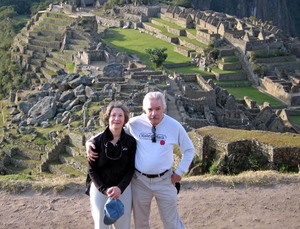
Like many other adventurers, my wife, Angela, and I had always put Machu Picchu, the ancient Inca citadel in Peru's Andes Mountains, high on our wish list of places to visit. We had had heard from friends who visited there that Machu Picchu had an almost mystical quality to it.
Still, we had no idea we would find the most spectacular mix of landscape and architecture we had ever seen, a stone settlement of temples, plazas, dwellings, steps and terraces - all of set against the natural splendor of the sheer rock walls of the Andes, rising out of the jungle.
The climax of our visit was when we hiked about four miles up from the ruins of Machu Picchu to an ancient stone structure, Intipunku, the Sun Gate, which is the front door to Machu Picchu from the Inca Trail. We felt as if we could kiss the sky. From this summit, we peered down at a breathtaking view of the crown jewel of the Inca empire.
The walls of Machu Picchu, dating back to the mid-1400s, have stood well against the forces of nature. There are several theories about the function of this fabled city. Some say it was a summer playground for the Incas; others say it was a religious retreat; and still others claim it was the last bastion against the invading Spanish conquistadores.
Whatever its purpose, Machu Picchu demonstrates that the Incas were master stonemasons. You can't help but marvel at the quality of their workmanship - stones fit together like glove to hand, and the Incas didn't have mortar.
We arrived in Machu Picchu - it's inaccessible by road - after a 3 1/2-hour train ride from Cusco, which was once the center of Inca civilization and is South America's oldest, continuously inhabited city. It acts as a kind of base camp for visitors to Machu Picchu, but it has become a popular destination in its own right.
As one of the highest cities in the world at more than 11,000 feet above sea level - or twice the altitude of Denver - Cusco takes some getting used to, especially if you arrive direct from Lima, which is at sea level.
We stayed at the Hotel Monasterio, a converted monastery dating back to the 1590s, that soothes its guests with Gregorian chants each morning and fully oxygenated rooms at night.
The locals advise visitors to drink coca tea, said to be made from the same coca leaves used to make cocaine. The natives say the tea, which has a woody, herbaceous flavor, helps prevent altitude sickness and increase energy. Coca leaves were also important to the Incas and were used for many religious ceremonies.
Wander through Cusco's cobbled streets, which branch off from the Plaza de Armas, the main square, and evidence of the Inca empire abounds. Several alleyways have original Inca stone walls and many of the buildings have been built on top of Inca foundations.
Cusco is designed in the shape of a puma, one of the mountain cats the Incas regarded as sacred. The head is high up on the hill to the north of the city's center, also the site of the ruins of Sacsayhuaman, which is pronounced "sexy woman."
Sacsayhuaman was the Inca ceremonial complex and, like Machu Picchu, it is also a wonder of stone masonry, where huge chunks of stone fit together with impeccable precision.
Cusco is also the hand-woven-textile center of Peru, so you're never far from a shop offering to dress you from head to toe in 100 percent alpaca clothing.
Our visit to Peru began in Lima, the sprawling capital of 9 million that is snarling with traffic and pollution. That being said, Lima is also a foodie mecca, generally known for its ceviche, or fresh, raw fish.
But who knew Peru gave the world the potato? It grows hundreds of varieties in more colors than you can imagine or count. I tried causa, a concoction of potato mashed in lime juice and the local indigenous pepper, aji, and filled or topped with everything from crab to avocado to octopus.
But the food wasn't the most intriguing thing we discovered in Lima. We observed that many residents, typically those in less-affluent neighborhoods, don't have roofs on their homes. This is not because it rarely rains in Lima but because some of the municipalities that make up greater Lima don't require residents living in unfinished homes to pay property taxes.
If you are planning a trip to Peru, consider going with a tour operator. We booked our trip with Abercrombie & Kent. They cater to the needs of baby-boomer clients who want an active day but a comfortable night, the best cuisine, personal escorts to and from airports and never having to worry about their bags being picked up.
We had some wonderful traveling companions, including actress' Julie Andrews' longtime lawyer (who had a cameo in her 2001 flick, "The Princess Diaries") and a Texas tycoon who's a pal of Gov. Rendell's brother.
One more reason to consider a trip to Peru is the favorable exchange rate - one of the few in the world right now. One U.S. dollar equals almost three of its Peruvian equivalent, the nuevo sol.


